
Alienage

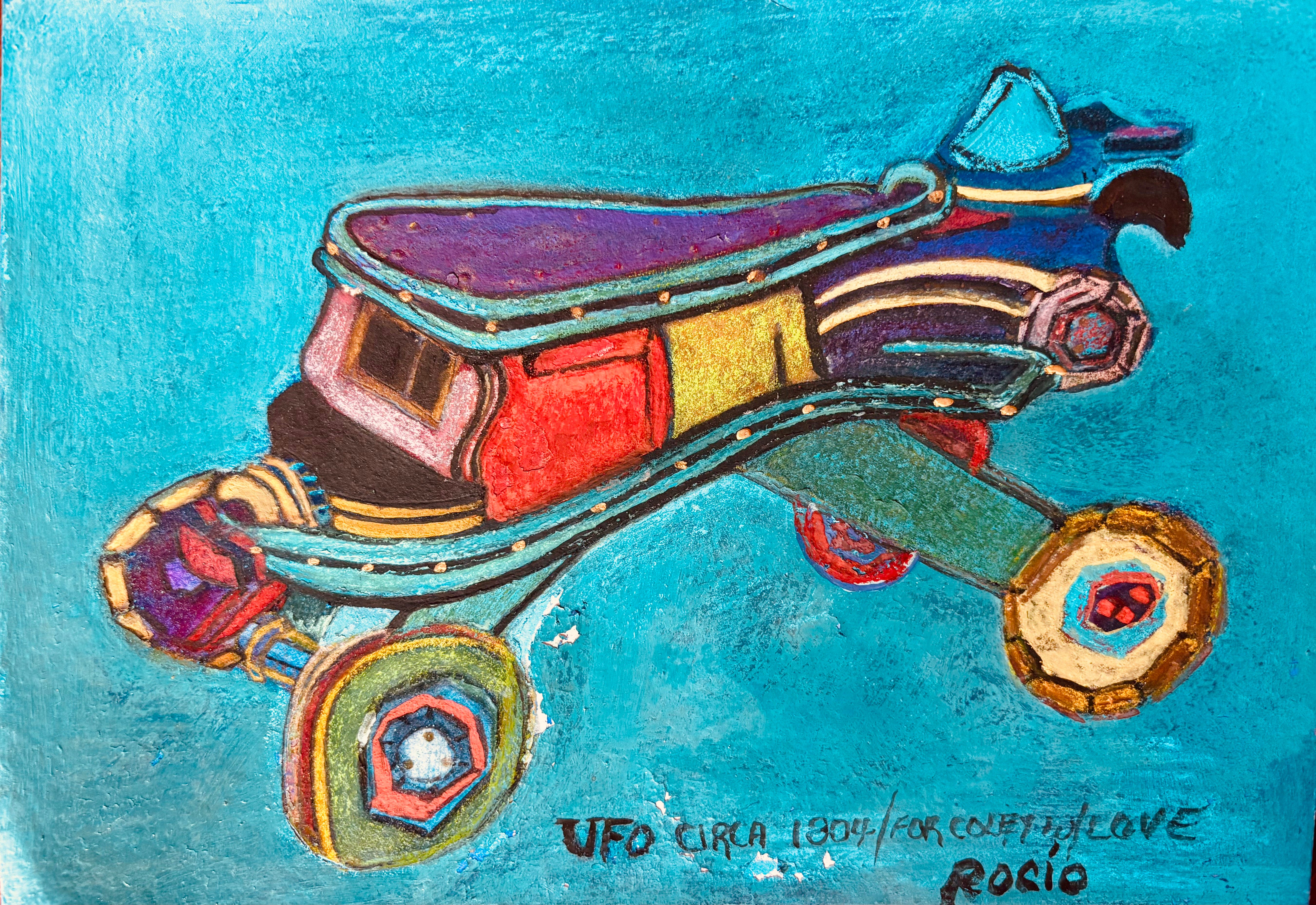
My mother could have been an alien. She was always talking about E.T.s, pondering their existence in the cosmos. When my sons were little, she painted them a spaceship she saw in a dream. I was 10 or 11 when she took me to see Close Encounters of the Third Kind, which at the time frightened me. Now, I can’t help but think her aliens were more a metaphor for a deep-seated desire to land someplace safe.
For decades, the U.S. government considered my mother an alien of the illegal variety, from a Mexican galaxy far far away. Years later, when she was in her forties, the government “naturalized” her (What was she before? Synthetic, a processed person?), but I don’t think it really ever took. Her naturalization coincided not with a more assimilated or North American version of herself, but rather a Rocío who was unapologetic about her roots.
I never asked her if she remembered the day she arrived in Laredo, Texas for the first time. If it was an ordinary international-bridge-crossing day, flatbed Fords, old cars, and buses bumper to bumper in both directions. Whether the sun was high in the sky and shining just enough to bring out the yellows and greens in the silty water of the Rio Grande. What month did she cross? What year? (Was she 13 or 14?) Was she alone? With one of my great aunts, my abuelita María, or her own mother? Did she walk across, holding her younger brothers’ hands, or did someone drive her and her siblings? What was she wearing? Was she scared?
There would have been children darting in between cars on the Mexican side, selling chicles. Old women wrapped in threadbare rebozos on the side of the road begging for pesos. Men selling newspapers or flowers or reindeer figures made from dried river reeds.
Or maybe not, actually.
I can’t imagine what the bridge looked like when my mother traveled its length for the first time. I can only conjure a mental timelapse based on my own numerous crossings as a kid in the 1970’s and 80’s.
I can’t remember my first trip into Nuevo Laredo, but I know the purpose was not to start a new life. I used to accompany my grandmother on errands, visit my tía Dina’s taco stand, dance at the discos as a teenager. Sometimes, we’d “go across” to shop at the grocery stores that were cheaper than the markets on the U.S. side. My grandmother always seemed to have someone to see about a thing: repairs to the car, a loan, or some other grown-up matter I had no interest in.
Once, when I was 9 or 10 years old, my grandmother bought me a parrot or we got one from a friend. She gave it some tequila and wrapped it snugly in a shoebox so it would sleep. I was to act normal at the border crossing when the border patrol agent looked inside at the occupants of our car. My grandmother spoke only Spanish, so it was on me to speak first. American citizen, I would say in perfect English. The details of that night are fuzzy, but I know they let us back into the country and never detected the parrot because a few weeks later, we drove it to Houston where it lived in a cage I hated cleaning.


It’s been many years since I’ve visited Nuevo Laredo. With an uptick in cartel violence in the late 80s and 90s, most Laredoans stopped going back and forth as often, if at all. No more circuses, riding on the backs of motorcycles, shoe shopping en el centro or going to the cine to watch old Mexican movies. No more licuados from street vendors or paletas de limón or fresh mangos from the mercado. No more Domani’s discoteca where I drank cuba libres and chain-smoked cigarettes before I could legally drive a car. No more panaderías and my favorite conchas. No more. No more. No more. That Nuevo Laredo is gone forever.
When I lived in Laredo, Texas with my grandmother in 1984, I was 15 years old. I enrolled at J.W. Nixon High School, the same school my mother had gone to twenty years earlier. She was on the dance team, a Golden Spur. I joined the debate club and took ballet classes. A few years after she graduated, she was pregnant with me. Before I had the chance to make similar life choices, I left Laredo at 16 to live with my dad and stepmom in an affluent East Coast suburb.
My mom never asked me what that trip to Washington, D.C. was like. Whether I was sad or happy to be leaving Texas. I don’t remember packing my bags or saying goodbye to my grandmother. I don’t remember if I flew to D.C. from Laredo or Houston. I don’t remember my father picking me up at the airport or what I thought when we pulled into the driveway of his large, two-story home with a pool in the backyard. This time I was crossing into a different world.
I never asked my mother how she felt about her only daughter moving across the country. I had already become something of a stranger to her. I think we both knew it was a point of no return.
Keep writing, Chica!!! Love it.
What a poignant story with your memories mixed in to paint a colorful life that is no more. It’s odd that you have no recollection of critical moments like saying goodbye to your mother, but you were a young girl most likely focused on other things that you judged important at that time. The sad fact is that my mother also came to the US on her own as a very young woman. She was the only child of parents she adored and living on a small island in a tiny country. I never thought to ask her what the goodbyes were like, and now my chance is gone, as she is also gone.